You answered the big question, said “I do”, and now what? If you’re Greek, you’re definitely thinking of having a big fat Greek wedding, and if you’re not, your parents are! If you’re not Greek, you may be dreaming of tying the knot in Greece. Whatever the scenario, you’ll need to know about Greek wedding traditions, which will undoubtedly enrich your big day in Greece or elsewhere.

In this post, I’ll take you through the diverse and beautiful Greek wedding traditions, many of which (believe it or not) go back to Ancient Greece. You can even read about these rituals in the writings of Euripides or Plutarch.
These traditions – a bit changed or updated to modern needs or borrowing from foreign practices – are still practiced today in Greek cities, towns and villages and anywhere in the world Greeks call home. I should let you know that like most Greek customs, they vary depending on region. So islands may have different wedding rituals than the mountain villages, but these differences are small and above all, fascinating.
So ready? Let’s learn about the cherished Greek wedding traditions, which include everything from the gifts given to the bride and groom during the engagement to who covers the bill!
Like in many cultures, the traditional Greek wedding is much more than a cultural or religious happening. It plays a significant social role: bringing people together.
The Engagement – ‘O Aravonas’

The engagement is when the bride’s family – including grand- and great-grand parents – meets the groom. It’s a big event and is celebrated, as Greeks always do, with lots of food and drink, song and dance. In Greek, it is known as the “aravonas”.
After the challenging social part of the event – family asks the groom all sorts of questions – the couple exchange engagement rings, or “veres” in Greek, which are worn on the left hand as a sign of promise and loyalty, and after the wedding ceremony, on the right.
➤ Fun fact: Wearing the wedding band on the fourth finger of the left hand dates back to Roman times and the Medieval era, when it was believed that a vein in this finger flowed directly to the heart. This vein was called the “Vena amoris.”
Traditional Engagement Gifts
During the “aravonas vengera” – extended engagement visit – tradition requires the bride’s family to offer the soon-to-be son-in-law a gift. This is usually an expensive gold watch. For the more modern types, gifts can also include jewelry like gold chains, a cross, cuff links, or even luxury stationary.
It is also customary that the mother-in-law offer a gift to her new ‘daughter’. This is often a precious family heirloom, something that was given to her by her mother, or gold jewelry: earrings, a necklace, a bracelet, a cross. In this way, she welcomes her daughter-in-law into the family.
What’s beautiful about Greek wedding traditions is that these too have changed with time. So for modern couples, gifts may be anything that celebrates the union and brings the two closer together. This could be a trip, a luxury hotel stay, a massage, a special dinner, concert or theater tickets, participation in an extreme sport.
➤ Fun fact: Unlike in the rest of Greece, where the father would choose a husband for his daughter, in ancient Sparta, women were often free to pick their own spouse.
Before the Wedding: The ‘Krevati’
One of the most exciting Greek wedding customs is the “krevati”, which means “bed”. Tradition has it that two days before the big day, female relatives and friends of the bride come to make the wedding bed. Picture lots of females laughing and singing and talking about ‘girl’ things. The sheets should definitely be white – the color of purity and new beginnings. Once the bed is made, they toss flowers and rice – which symbolize wealth and stability, and “koufeta” (sugar-coated almonds), which represent the sweetness of married life. Children are often invited to roll or jump on the bed, bringing with them innocence and blessings for fertility.
More Greek Pre-wedding Traditions
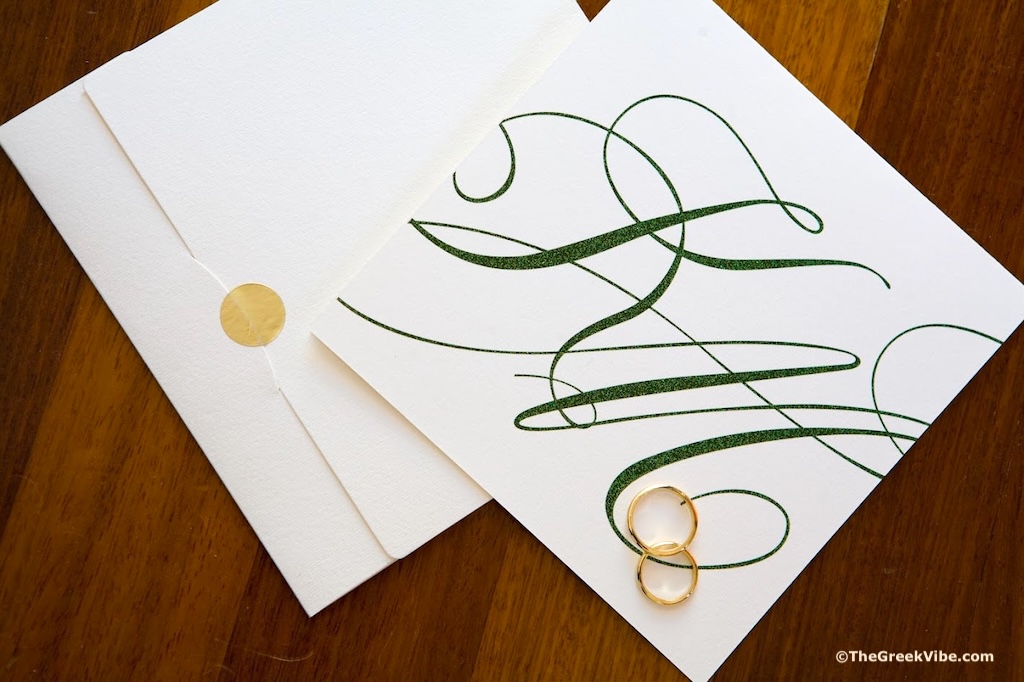
As the big moment draws near, the hustle and bustle in the Greek household is ongoing. There’s lots of loud talk, giggling, excitement with a touch of nervousness. Couldn’t be any other way! Greeks are loud, outgoing and love chaos! It’s a Greek word, after all!
In Greek mythology, Chaos was the first primordial being, our original state of existence before the universe took shape. It was from chaos that the first elements of the cosmos emerged. So as you understand, a little bit of chaos is natural, especially before any big, fat Greek event.
➤ Fun fact: In the past, the Greek bride’s dowry (“proika”), which included sheets, linen, tablecloths, blankets and other items, would be taken to her new home by her friends accompanied by musicians playing traditional wedding songs.
The Greek Wedding Day
On the big day, the bride and groom get ready separately, usually surrounded by family and close friends. Relatives come and go, music is playing, colorful trays of handmade Greek sweets and coffee are passed around, the elders share their wedding stories, and everyone is happy.
Shaving the groom
A very popular Greek wedding tradition involves the groom. Remember, way back in the day, in the remote Greek villages or on the islands, there were no clubs to have bachelor’s parties as we know them today. Instead, close male friends led by the best man would ceremonially “shave the groom” with a silver razor! The idea is to prepare the groom for a fresh new beginning, to initiate him into married life, and to ward off any bad energy.
Silver in Her Shoe
And what about the bride? While she’s busy getting beautiful for the ceremony, the “koumbari” (best man or maid of honor, or both), along with friends and relatives place a piece of silver in her shoe as a symbol of prosperity and good fortune. This is known as the “asimoma” (“silver” in Greek), a ‘silver-coated’ blessing for health, wealth, and happiness.
Names Under Her Shoe
Another popular Greek pre-wedding custom has unwed friends of the bride writing their names on the sole of her shoe! According to tradition, the names that rub off first are the ones most likely to marry soon.
🧿 Fun fact: Most of Greece’s pre-wedding customs and traditions are also meant to ward off potential bad vibes.
The Stefana

There can be no Greek wedding without the “stefana” – the intricately designed wedding wreaths connected with a lace or satin ribbon and worn during the church service. Depending on the wealth of the family, in the past, these were made from silver or gold and adorned with pearls or were simple olive branches dressed in flowers.
The “stefana” are placed on the heads of the couple by the koumbaros (best man/woman), who switches them back and forth three times symbolizing the blessed union, the commitment, and the splendor of married life.
In the past, the stefana were kept in an obvious place in the home. Despite having changed many homes in my childhood years, I remember there always being a spot in our family home for my parents’ stefana. To this day, they can be found in a glass frame by the “ikonostasi”, so that God protect the wedding at all times.
For the Greeks, the “stefana” are family heirlooms passed down from one generation to the next as a symbol of good fortune and eternal love.
Today, you can find stefana of all sorts and for all tastes and pockets in wedding specialty shops. The prices can range from €20 to several hundred euros depending on materials used.
The Bombonieres

Or in other words, the wedding favors! Once the church ceremony is over, guests are treated to a “bomboniera”, a small token of appreciation for sharing in the couple’s special day. The bomboniera is not your usual party favor, it too carries a deeply symbolic meaning.
The bomboniera is usually a small tulle pouch with an ornament tied with a ribbon or lace. Inside you will find five “koufeta” (sugar-coated almonds). Today, you can also find sumptuous chocolate varieties.
The number of the koufeta in each pouch should be odd – 5, 7, or 9 – a number that cannot be divided – exactly our wish for the couple!
The koufeta symbolize health and spiritual well-being; prosperity and stability; happiness; fertility (the hope for children and a large family); and a long life together.
The almonds represent the bittersweet nature of marriage; the challenges that require commitment, patience, and understanding. The sugar coating reminds us of the sweetness of love that helps us to overcome difficulties.
In the past, young women in the villages would place the koufeta under their pillow hoping to dream of their future spouse.
Bombonieres are also handed out at modern Greek civil weddings.
➤ Fun fact: The ancient Greeks believed that the best time for a wedding was in winter. The Athenians named this season, which fell in January, “Gamiliona,” a month dedicated to the celebration of the Greek gods Zeus and Hera.
Throwing Rice
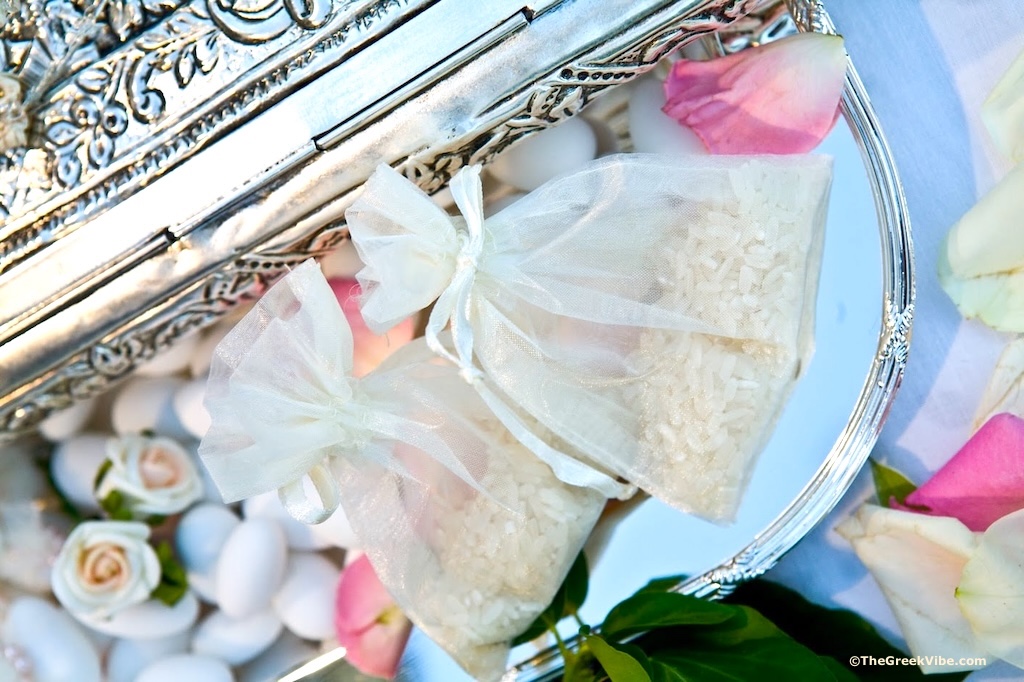
One of the most entertaining Greek wedding traditions is throwing rice at the newlyweds during the Dance of Isaiah (see below).
This fun custom symbolizes prosperity, fertility, abundance and good fortune. It comes from the idea that like rice which grows and multiplies fast, so should the bond between the couple.
The rice mix – usually combined with fragrant rose petals and dried lavender – is handed out before the Dance of Isaiah by the bridesmaids. This too can be found at wedding specialty shops.
In the last few years, especially in cities, many churches have banned this tradition or transferred it outdoors as the couple exits the church. Instead of rice, flower petals are thrown or even confetti. The idea however is the same.
The Koumbaros or Koumbara
In a Greek wedding, right after the bride and groom, stealing the show is definitely the koumbaros or koumbara (the best man or maid of honor). They play a key role in the Greek wedding ritual, and are considered part of the family once the couple is officially wed. In the past in Greece, and particularly on Crete, families would strategically choose the koumbaro so as to safeguard their interests, strengthen their influence in the community, or even expand their reach. Today, the best man or woman are usually close friends of the couple.
The ‘Μystirio’ or Wedding Ceremony
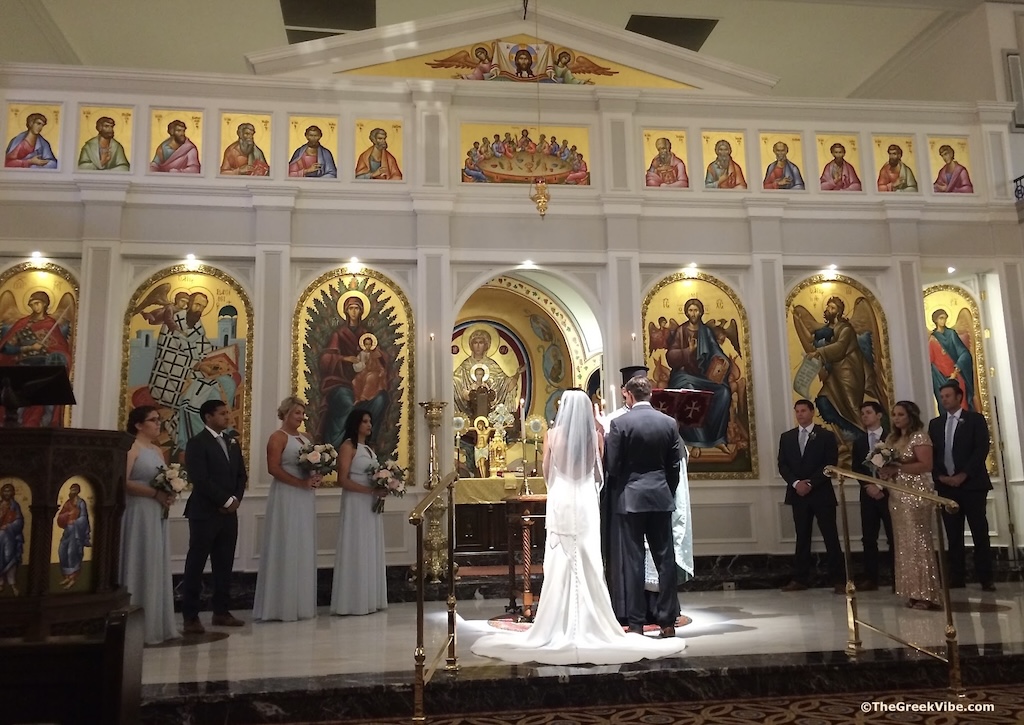
If we want to be totally correct, this section describes the Sacrament of Holy Matrimony, or in everyday terms, the Greek Orthodox wedding ceremony. The traditional Greek wedding takes place on Sunday at a Greek Orthodox church with an ordained priest in the presence of the best man or maid of honor (koumbaros or koumbara) and guests.
The atmosphere is filled with anticipation. The groom waits patiently outside the church with a bouquet of flowers in hand as the guests gather. It is typical for the bride to be late. Today, she usually arrives by car, but in the past, and particularly in the Greek villages, she would make her grand entrance on a mule or in a horse-drawn carriage. In some villages, she was (and still is) accompanied by musicians playing traditional Greek wedding songs.
Once she arrives, she is escorted to the altar by her father.
➤ Fun fact: The Greek wedding maintains rituals that go back more than 2,000 years.
The church service is deeply spiritual. Traditionally quite long, it is divided into two parts: the Service of Betrothal and the Service of Crowning. The priest begins by blessing the rings (veres) and the stefana, the wedding wreaths that will later be placed on the couple’s heads. One of the most moving moments follows: the Dance of Isaiah.
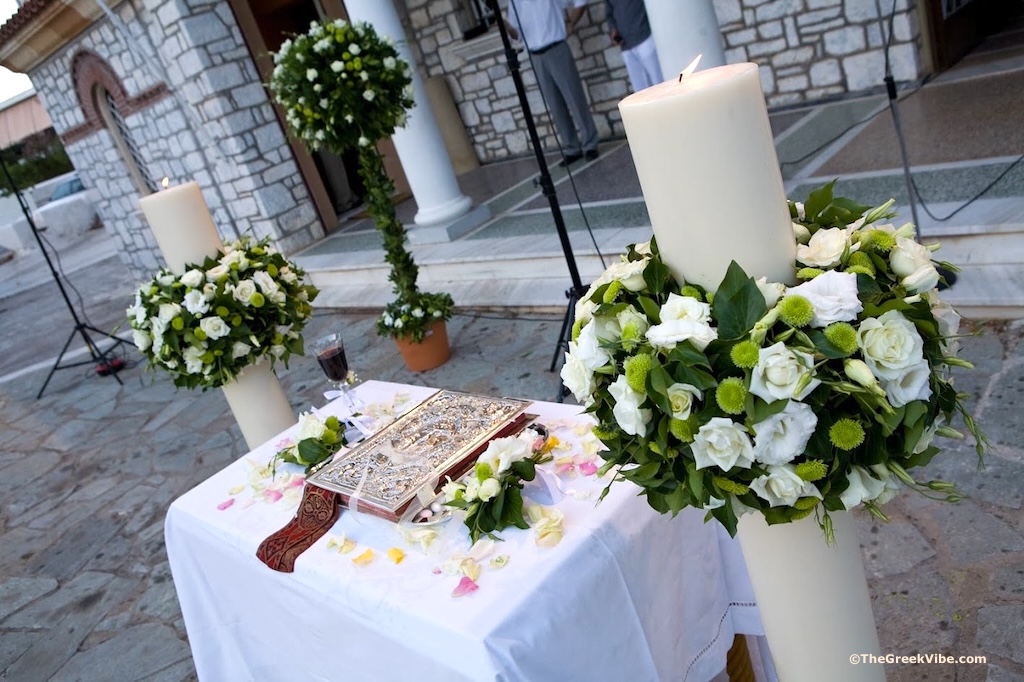
Guided by the priest, who holds the Gospel and chants hymns, the couple walks in a circle around the altar three times, their stefana linked by a ribbon held by the koumbaros or koumbara. These are the couple’s first steps in life together. And this is where we customarily throw the rice wishing love, health and happiness.
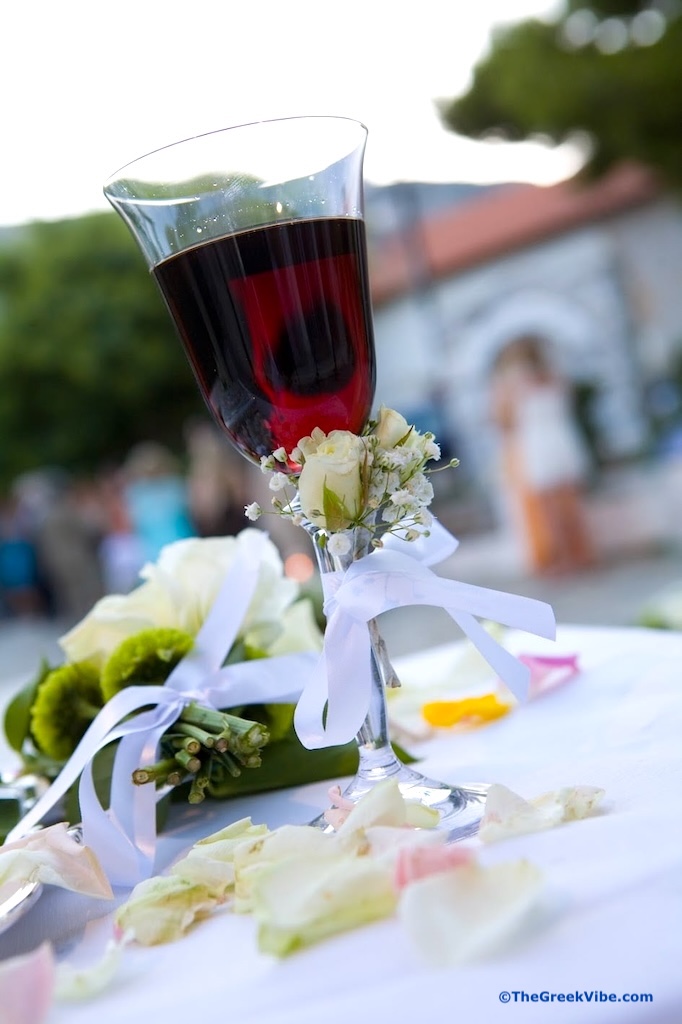
Unlike many Western ceremonies, there are no spoken vows. Instead, the gift of marriage is conveyed through the ritual itself, which also includes drinking from a shared goblet of blessed wine. A sip later you know that you will from now on share everything in life with your partner: happiness and hardship, joy and sorrow.
📍5+1 Reasons to Marry or Honeymoon in Greece
When the ceremony comes to a close, the priest removes the stefana and offers his blessing, wishing the couple a long and happy life together.
In true Western wedding style, the Greek bride will, of course, toss her bridal bouquet into the crowd… and may the best free person win (the catch)!
But the celebration doesn’t end at the church doors. Outside, the newlyweds are greeted with warm embraces, heartfelt congratulations, and countless photographs with family and friends. It is here that guests are offered bombonieres and sweets.
The Greek Wedding Party (Glenti)

Greek weddings have long been and continue to be grand events with many guests. In the past, the entire village was invited to the celebrations known as the “glenti”, which in many cases lasted for days. This still applies on Crete, where wedding festivities last for two or three days.
In modern Greek cities, the wedding party is usually held at venues on estate properties or even at all-day bars overlooking the sea.
In the US, Canada, and Australia, home to many diaspora Greeks, wedding receptions take place in big banquet halls.
One of the Greek wedding traditions that still lives on today is the “meloma”, which means to “sweeten with honey”. I vividly remember as the koumbara being welcomed into the village home right after the couple with a spoonful of Greek honey and walnuts. This gesture symbolizes the sweetness and fertility of life ahead for the couple.
Custom dictates that the first dance of the evening is led by bride and we have a special traditional song for this: “Beautiful is the Bride”. The groom and the koumbari follow… and after that the party is officially on!,
➤ Fun fact: Sometimes during the reception, guests may pin money to the bride’s dress while she’s dancing or shower the couple with bills as a wish of prosperity. This came down to us from the past. Today, it has for the most part been replaced by gifts and a wedding gift list. Both past and present, it represents friends helping the couple begin married life with abundance and blessings.
With the first dance, the big “glenti” (which means party) begins. What do big fat Greek weddings always have? Lots of food, drink, and dancing! And of course, the “tourta”, or the towering wedding cake! Have in mind, that couples may spend weeks ahead sampling cakes to make sure they offer their guests and families only the best.
Traditional Greek Wedding Treats and Breads
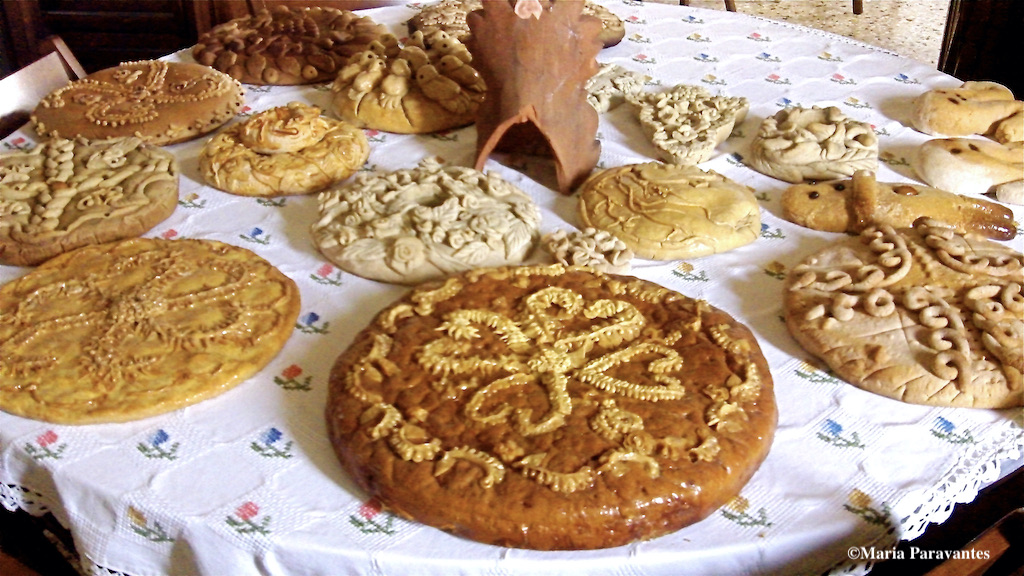
Where to begin! Like I said before, each region, island and even village in Greece has its own customary wedding dishes and sweets, but one thing common in all is the “Gamokoulouro” or wedding bread. This round, ornate bread is a work of art, decorated with pomegranates, grapes and pine nuts: symbols of fertility, prosperity, and abundance.
In addition to meat – lamb, goat or pork – Greek wedding tables must be abundant with the very best on offer, just like the life of the married couple should be.
Crete boasts one of the most iconic wedding dishes: the “gamopilafo” – a special risotto cooked in the broth from boiled lamb of goat. Rice features here too symbolic of fertility and wealth.
I should also note that with the bombonieres at the end of the ceremony, guests are also treated to specially made wedding sweets. On the Greek islands, the bombonieres are often accompanied by homemade “pasteli” (the famous Greek sesame and honey sweet) or “xyrotigana” (honey fritters), and on mainland Greece with the “diples” (delicate, fried pastries drizzled with honey).
➤ Fun fact: On the Greek island of Crete, shooting in the air to mark the celebration was an absolute must. This custom, known as “balothies” (gunfire), is still practiced to express joy although it is dangerous and illegal.
Who Pays for What

And now for the question I’m sure everyone has been wanting to ask. Who pays the wedding’s big fat bill? Which, in addition to the wedding gown and suit, rings, invitations, bombonieres, also includes the church services, the wedding cake, the catering services or venue, the flower decorations, the photographer, and of course, the legal papers.
Let’s break it down:
The family of the bride

Traditionally, the bride’s family covers most of the wedding costs and this because many decades ago, a woman had to have a big dowry (proika), if she wanted a chance to marry well. This practice has thankfully changed but the family of the bride does end up bearing the cost.
This includes:
– the wedding ceremony
– the venue
– the flower arrangements
– the honeymoon
– the bride’s makeup, hair, accessories
– the groom’s shirt, tie, cufflinks, shoes, and other accessories
The family of the groom
– the bridal gown
– the suit
The koumbaros (best man/woman)
– the church service and the priest
– the stefana and the chalice
– the church decorations
– the gift to the newlyweds
– the trays, decanters and glasses.
➤ Fun fact: According to Greek tradition, since the best man or maid of honor are considered our spiritual family, they are also usually expected to baptize the couple’s first child.
The couple
Today, many couples decide instead to share the cost, which is only fair.
So the couple pays for:
– the wedding rings
– the invitations and wedding favors (bombonieres)
– the wedding documents
-the DJ or live band
– the photographer and video
– the gift for the koumbaro (best man, maid of honor)
– the wedding cake.
What do you wish a newly-wed Greek couple?
💐 “Na zisei e nyfi ke o gambros” (long live the bride and groom) or just “Na Zisete” (A good long life to you).
👉🏼 Dream of visiting Greece? Start planning
♫ I end today’s post with one of my favorite traditional (demotika) Greek wedding songs. I admit, I get teary every time I hear it! The song, performed here by Yiannis Parios, is a Greek island song titled “It’s a wedding day today” (“Simera Gamos Ginete”).
Enjoy!
Enjoyed this Post? Share and Pin it!